How do plants regenerate damaged tissues and produce new individuals?
Plants can not only repair damaged tissues, but also produce new organs or even new individuals from parts of their bodies, such as leaves, stems, roots, and gemmae. This remarkable ability for regeneration and vegetative propagation is an important trait that allows plants to survive, multiply, and adapt to diverse environments while remaining in the places where they grow.
However, not all plant cells regenerate in the same way. Many questions remain unanswered: Which cells or tissues become the starting points for new growth? How do cell identities change during regeneration? How are new body axes and meristems established? And how do plant hormones and cell polarity contribute to these processes?
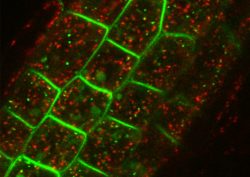
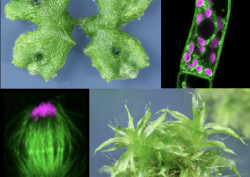
In our laboratory, we study the processes of vegetative propagation and tissue regeneration using bryophytes and ferns. In particular, by using live imaging and microscopy, we aim to understand where regeneration-initiating cells emerge, how cell division and cell polarity change, how plant hormones act, and how new organs or body axes are formed.
Our current and future research projects include:
1. Mechanisms of vegetative propagation
2. Mechanisms of tissue regeneration
3.Regulation of cellular totipotency underlying vegetative propagation and tissue regeneration
Learn more about the research
1. Mechanisms of vegetative propagation
Vegetative propagation allows plants to produce new individuals from parts of their bodies. We are interested in how specific cells and tissues initiate new growth, establish developmental polarity, and generate new plant bodies during this process.
2. Mechanisms of tissue regeneration
Plants have a remarkable ability to repair damaged tissues and regenerate new organs. We aim to understand how cell identity, cell division, plant hormones, and tissue polarity are reorganized during regeneration.
3. Regulation of cellular totipotency underlying vegetative propagation and tissue regeneration
Vegetative propagation and regeneration are closely related to the ability of plant cells to change their developmental state. We are interested in how cellular totipotency or pluripotency is regulated in different plant lineages, including bryophytes and ferns.
Detailed descriptions of these projects will be added soon.