How do plants change their body form in response to the environment?
Unlike animals, plants cannot move away from unfavorable environments. When they are exposed to changes in light, gravity, drought, wounding, pathogens, or other environmental conditions, how do they respond while remaining in the same place? Plants survive by changing their growth direction and body form according to the surrounding environment. Interestingly, the mechanisms that underlie these environmental responses are closely linked to the mechanisms used in development and morphogenesis.
Our current and future research projects include:
1. Asymmetric cell division: How is asymmetry generated during the first division of moss spores?
2. Light- and gravity-dependent regulation of plant development: How do light and gravity signals control stem cell position and fate in bryophytes?
3. Membrane dynamics centered on PIN clusters and VAN3 during environmental responses
4. Cell membrane domain dynamics during environmental stress responses, including soil conditions and pathogen responses.
Learn more about the research
1. Asymmetric cell division: How is asymmetric generated during the first division of spores?
Cell divisions that generate daughter cells with different morphologies or fates are called asymmetric cell divisions. Such divisions are widely observed during the development of multicellular organisms and play important roles in stem cell maintenance and cell differentiation. In plants, cells cannot freely move because they are surrounded by cell walls. Therefore, where and how a cell divides can have a major impact on subsequent tissue and organ formation.
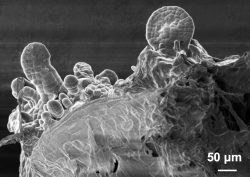
We focus on the first asymmetric division of moss spores. In this division, one daughter cell becomes an undifferentiated cell that will later function as a stem cell, whereas the other differentiates into a rhizoid. This simple developmental system provides an excellent opportunity to investigate how cellular asymmetry is generated and how it leads to differences in cell fate.
Recent observations suggest that the orientation of the first division in moss spores may be influenced by light and gravity. By combining live imaging and molecular markers, we aim to understand how light and gravity signals regulate intracellular polarity and division orientation, and thereby uncover fundamental mechanisms of asymmetric cell division in plant development and morphogenesis.
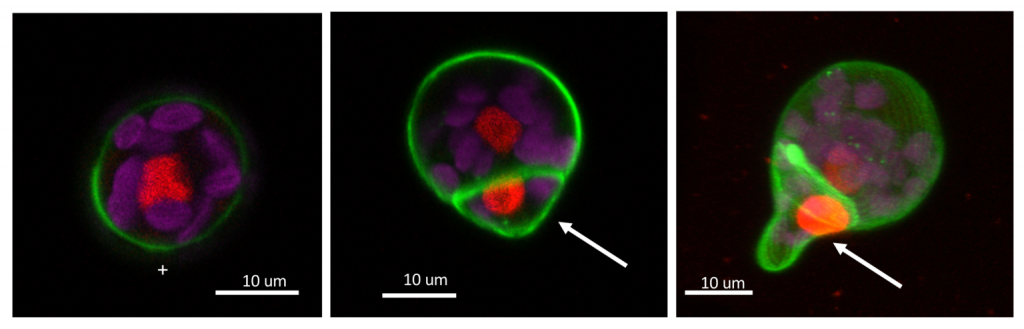
First cell division of M. polymorpha spores
2. Light- and gravity-dependent regulation of plant development: How do light and gravity signals control stem cell position and fate in bryophytes?
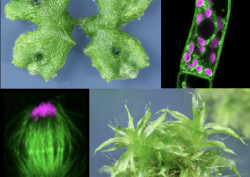
Plants use the direction of light and gravity as cues to determine their body orientation and growth direction. In the development of bryophytes such as liverworts and mosses, these signals are also thought to play important roles in body-axis formation and stem cell fate determination.
We are interested in how auxin transport and PIN proteins contribute to these processes. In liverworts, disruption of auxin transport or PIN function can lead to defects in dorsiventral axis formation and stem cell regulation. Similar developmental abnormalities can also be observed when light direction or gravity responses are perturbed, suggesting that light and gravity signals may act together with auxin transport to control the position and fate of stem cells.
In this project, we aim to understand how light and gravity information is translated into spatiotemporal differences within developing tissues, and how these differences lead to stem cell maintenance, stem cell inactivation, and body-axis formation. Through this work, we also hope to gain insight into the evolutionary roles of auxin and PIN proteins in the formation of plant body axes.
Clinostat: an experimental device that rotates plant samples to continuously change the direction of gravity relative to the plant body. This rotation can average the effect of gravity over time and is therefore useful for analyzing plant growth responses associated with gravity sensing.
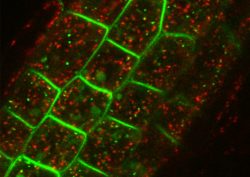
3. Membrane dynamics centered on PIN clusters and VAN3 during environmental responses
Animals can move to more favorable environments when conditions become unfavorable. Plants, in contrast, must respond by changing their growth direction, organ formation, and body form. One important mechanism underlying this response is the regulation of auxin transport and the localization of PIN auxin transporters.
Our laboratory focuses on PIN clusters, which are structures formed by PIN proteins on the plasma membrane. PIN clusters may change their state not only during normal development and growth, but also in response to environmental stimuli such as light, gravity, and soil conditions. VAN3, a factor involved in PIN localization, and changes in the plasma membrane environment are also likely to be important links between environmental responses and morphogenesis.
We aim to analyze the dynamics of PIN clusters and VAN3 under various environmental conditions using live imaging. By doing so, we hope to understand how external stimuli alter molecular organization at the plasma membrane and how these changes regulate auxin transport and plant morphogenesis.
4. Cell membrane domain dynamics during environmental stress responses, including soil conditions and pathogen responses
The plasma membrane is not merely a boundary of the cell. It is an important platform for sensing external conditions and transmitting information into the cell. Recent studies have shown that the composition and distribution of phospholipids and membrane proteins can change dynamically in response to environmental conditions.
VAN3, which we have studied for many years, is regulated by the phospholipid environment of the plasma membrane. VAN3 is involved not only in auxin transport and leaf venation pattern formation, but may also function in responses to changes in soil conditions and pathogen attack.
In this project, we aim to investigate changes in the membrane environment centered on VAN3 using imaging and physiological approaches. We seek to understand how plants perceive external environmental changes at the plasma membrane and connect them to the regulation of development and growth. We also aim to clarify the relationship among VAN3, PIN proteins, and PIN clusters, and thereby understand the roles of plasma membrane domains in linking environmental responses with auxin transport.