How do plants establish body axes and tissue patterns
Plant morphogenesis depends deeply on the polarity of individual cells. When specific proteins accumulate on one side of a cell, cellular polarity is established. When such polarity is coordinated across tissues, it determines the direction of plant hormone flow, growth direction, body-axis formation, and organ patterning.
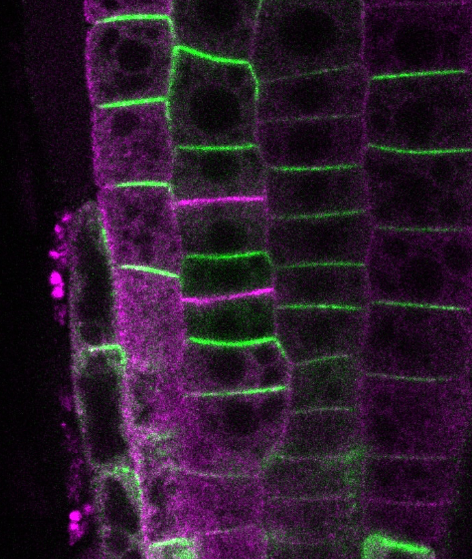
In our laboratory, we focus on PIN proteins, which transport the plant hormone auxin. Recently, we found that PIN proteins form specific structures on the plasma membrane, which we call “PIN clusters.” Using these PIN clusters as a starting point, we aim to understand how the spatial organization of molecules on the plasma membrane contributes to cellular polarity and plant morphogenesis.
Our current research projects include:
1. Understanding plant cell polarity and body-axis formation through the formation and function of PIN clusters
2. Plant-specific pattern formation: How are leaf venation patterns established?
3. Mechanisms of cell polarity formation from the viewpoint of VAN3 and membrane dynamics
Learn more about the research
1. Understanding plant cell polarity and body-axis formation through the formation and function of PIN clusters
Mechanisms of PIN cluster formation and disassembly
Proper formation of cell polarity and body axes is essential for the development of multicellular organisms. In vascular plants, body-axis formation and organ formation are closely linked to polar auxin transport. The direction of auxin transport is determined by the polar localization of PIN auxin transporters at specific sides of the plasma membrane.
For many years, it was widely thought that the polar localization of PIN proteins was maintained mainly by membrane trafficking, in which PIN proteins are recycled between endosomal compartments and specific regions of the plasma membrane. However, recent studies suggest that this model alone may not fully explain the stable polar localization of PIN proteins. We propose that PIN clusters formed on the plasma membrane play an important role in stabilizing PIN localization and establishing cellular polarity.
We are currently investigating the molecular structure, chemical properties, formation mechanisms, and functional significance of PIN clusters. By studying how PIN clusters form and disassemble, we aim to understand how molecular assemblies on the plasma membrane generate cellular polarity and contribute to plant body-axis formation.
Mechanisms of auxin canalization hypothesis
Auxin is thought to have the ability to reinforce its own directional flow between cells. This idea is known as the auxin canalization hypothesis. According to this hypothesis, auxin promotes its own efflux from cells through a positive feedback mechanism, thereby generating self-organized auxin transport routes.
We are studying the behavior of PIN clusters during plant development in detail. Our observations suggest that PIN clusters show characteristic dynamics during cell division and polarity re-establishment. By combining live imaging of auxin dynamics, local perturbation of auxin at the cellular level, and mathematical modeling, we aim to test the auxin canalization hypothesis and develop new models for how cell polarity and body axes are formed.
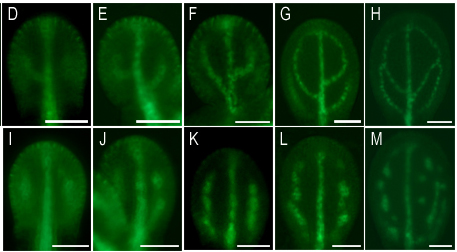
2. Plant-specific pattern formation: How are leaf venation patterns established?
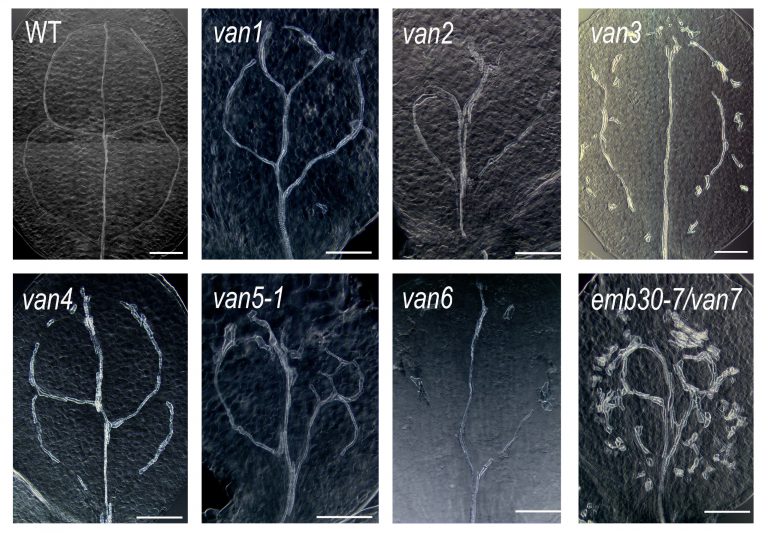
Leaf venation pattern formation is a complex developmental process involving cell division, vascular differentiation, cellular polarity, and auxin transport. Although leaf veins appear as stable patterns in mature leaves, their formation depends on dynamic cellular and molecular processes during development.
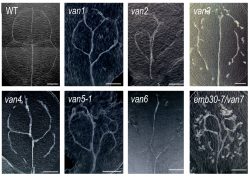
We previously isolated van mutants, which show abnormal leaf venation patterns, and identified several of the responsible genes. VAN3, VAN7, and VAN4 encode factors involved in membrane trafficking and plasma membrane organization. These factors function in the regulation of PIN localization and thereby influence leaf venation pattern formation.
However, it remains unclear how molecular events inside individual cells are translated into tissue-level patterns such as leaf venation networks. To understand this process, it will be necessary to combine molecular genetics with live imaging, visualization of auxin dynamics, spatiotemporal analysis of cell division, and mathematical modeling or simulation approaches.
By analyzing van mutants and PIN clusters, we aim to understand how molecular behavior at the cellular level generates tissue-level patterns in plants.
(Koizumi et al., 2000)
3. Mechanisms of cell polarity formation from the viewpoint of VAN3 and membrane dynamics
The plasma membrane is not merely a boundary of the cell. It is a dynamic platform where phospholipids, membrane proteins, membrane trafficking pathways, and the cytoskeleton interact to create specific sites for molecular localization and activity. The polar localization of PIN proteins is likely established not by PIN proteins alone, but through coordinated regulation involving the plasma membrane environment, membrane trafficking, and cytoskeletal dynamics.
VAN3, which we have studied for many years, contains domains related to membranes and phospholipids and is involved in PIN localization and leaf venation pattern formation. VAN3 activity and localization are regulated by the phospholipid environment of the plasma membrane, suggesting that VAN3 is an important factor linking membrane organization to cellular polarity.
We are investigating how VAN3, the phospholipid environment of the plasma membrane, membrane shape, the cytoskeleton, and membrane trafficking cooperate to regulate PIN localization. We are also analyzing phospholipid-metabolizing enzymes such as CVP2 and factors that interact with VAN3, with the aim of understanding how membrane dynamics contribute to cell polarity formation in plant cells.
Some VAN3-related factors may also interact with small GTPases such as Rab and Rop proteins. Small GTPases act as molecular switches that regulate membrane trafficking, cytoskeletal organization, and cellular polarity. By studying how plant-specific factors coordinate these molecular switches at the cell surface, we aim to uncover mechanisms of polarity formation that are unique to plant cells.